GST Registration Reforms 2026: What Every Business Owner and E-Commerce Seller Must Know
Explore how India's 2026 GST reforms—Multi-State Registration and Rule 14B—impact e-commerce sellers and virtual office compliance. Understand why separate stat
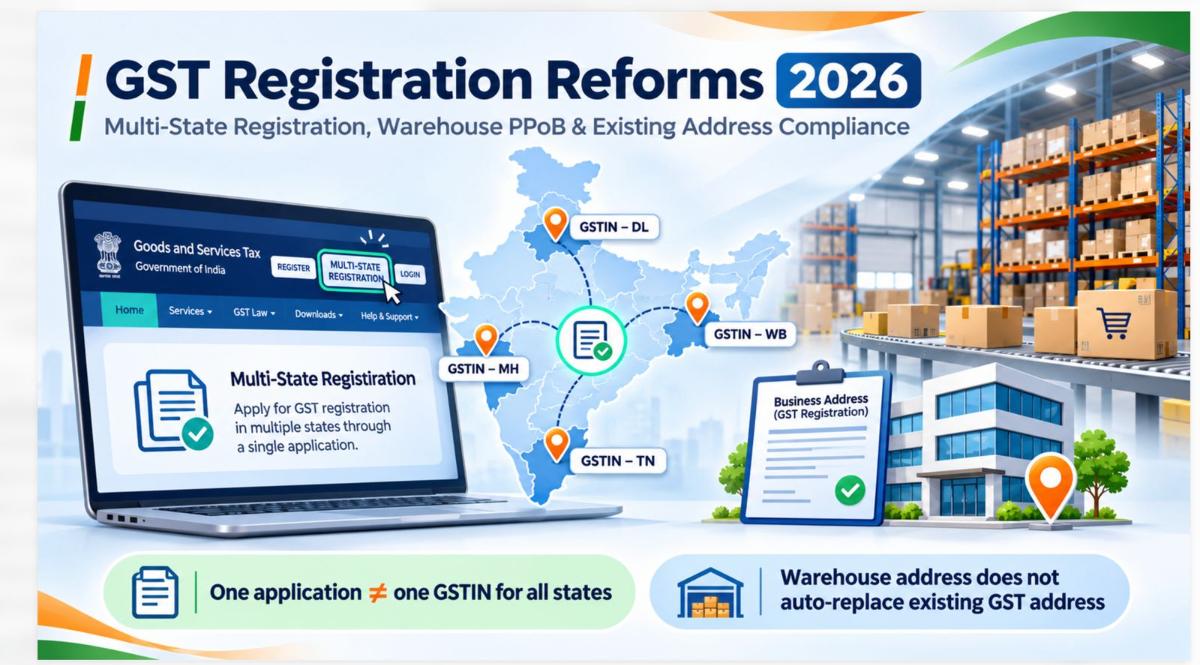
Multi-State GST Registration | New Rule 14B | Amazon Warehouse Address | Virtual Office Compliance
Multi-State GST Registration | New Rule 14B | Amazon Warehouse Address | Virtual Office Compliance
Published by Bharat Office Setu | 12 November 2026
India's GST system has introduced two significant developments that could change how businesses approach interstate expansion and e-commerce operations.
The first is the new Multi-State Registration facility, which allows businesses to apply for GST registrations across multiple states through a more streamlined process.
The second is GST Rule 14B, which introduces a special registration mechanism allowing eligible e-commerce sellers to use an approved e-commerce operator's warehouse as their Principal Place of Business (PPoB) in another state.
Both developments are positive steps towards simplifying business operations.
However, they have also created a serious misunderstanding among some taxpayers:
Does one GSTIN now work across India? Can every Amazon seller use a warehouse address instead of a virtual office? Can a seller discontinue an existing registered business address without making changes on the GST Portal?
The answer to all three questions is no—not automatically
Here is what business owners need to understand.
#1. Multi-State GST Registration: A Single Application Facility, Not a Single GSTIN
On 1 October 2026, GSTN introduced the Multi-State Registration facility.
This facility enables eligible businesses to initiate GST registration applications for multiple states or union territories through a common registration process.
Previously, business owners applying for GST registrations in different states had to repeatedly enter much of the same information.
The new system allows applicants to submit common business details using a Master Temporary Reference Number (TRN), followed by individual state-specific applications.
----An example
Suppose an e-commerce seller wants to establish registered business operations in:
- Delhi
- Haryana
- Maharashtra
- Karnataka
The new facility makes the application process more convenient.
However, the business must still obtain a separate GSTIN for each state where a separate registration is required.
The facility does not create a single nationwide GST registration.
What remains unchanged?
- State-wise GST registration requirements continue to apply.
- Each state-specific registration requires appropriate business address details.
- Relevant supporting documents and verification requirements continue.
- Returns, tax payments and other compliance obligations remain applicable to individual registrations.
The government has simplified how businesses apply for multiple GST registrations. It has not replaced state-wise GST registration with one universal GSTIN.
2. GST Rule 14B: A New Opportunity for E-Commerce Sellers
Effective 1 November 2026, Rule 14B of the CGST Rules introduced an important alternative for eligible businesses supplying goods through e-commerce operators.
Under the scheme, an eligible seller already registered in a home state may obtain registration in another state where the seller has no physical presence by declaring an approved e-commerce operator's warehouse as its Principal Place of Business.
For example, an eligible Amazon seller may be able to use an Amazon warehouse as the registered business address for a new GST registration in another state.
This could reduce the need for certain sellers to arrange a separate physical or virtual office address exclusively for that registration.
But there are important conditions
The scheme is not an unconditional exemption from GST registration requirements.
Among other requirements:
1. The seller must have a qualifying GST registration in the home state where the business has a physical presence.
2. The proposed registration must be in another state or union territory where the seller has no physical presence or existing active regular registration.
3. Supplies through the registration must meet the prescribed e-commerce operator conditions.
4. The output tax liability on specified supplies to registered persons must remain within the ₹2.5 lakh monthly limit.
5. The e-commerce operator must provide consent to the use of its warehouse as the PPoB.
Simply storing goods at an Amazon warehouse does not automatically authorize a seller to declare that warehouse as its registered business address.
The required approval and GST registration procedures must be completed.
3. The Biggest Misunderstanding: Does the New Policy Automatically Remove an Existing GST Address?
Absolutely not.
This is particularly important for businesses currently using virtual office addresses, shared business premises or third-party address services.
Consider the following situation.
An e-commerce seller obtained GST registration in Maharashtra using a business address provided by a professional address service provider.
The seller subsequently hears about Rule 14B and assumes that an Amazon warehouse can now replace that address.
The seller then decides to discontinue the existing address service.
But there is one critical issue:
The original business address is still recorded on the GST registration certificate.
A new government policy does not automatically amend existing taxpayer records.
Furthermore, Rule 14B provides a specific route for eligible new registrations. It does not automatically convert an existing regular GST registration into a warehouse-based registration.
Any transition must be assessed against the applicable provisions and completed through the legally appropriate process.
The distinction every seller must understand
Commercial arrangement: Your agreement with a business address service provider.
Statutory registration: The address officially declared in your GST registration records.
These are related, but they are not the same thing.
Cancelling a service agreement does not automatically update the GST Portal.
Similarly, an address continuing to appear on the GST Portal does not automatically entitle a customer to use the premises after contractual authorization has ended.
Businesses must ensure that both their commercial arrangements and statutory records remain accurate.
4. Planning to Discontinue Your Existing Virtual Office? Follow This Process First.
If your current GST registration reflects a business address arranged through Bharat Office Setu or another service provider, follow these steps before making changes.
Step 1: Review your current GST certificate
Verify the existing Principal Place of Business and any Additional Places of Business associated with your GSTIN.
Step 2: Determine your eligibility
Consult your GST professional to confirm whether Rule 14B is available in your circumstances.
An existing regular GST registration cannot automatically be treated as a registration under Rule 14B.
Step 3: Obtain confirmation from Amazon or the relevant e-commerce operator
Contact the e-commerce operator to determine whether its warehouse can be used for the proposed GST registration.
Approval is subject to the applicable registration process.
Step 4: Complete the appropriate GST formalities
Depending on the facts, this may involve a fresh registration application, amendment or cancellation of an existing registration.
Your GST consultant should determine the legally appropriate route.
Step 5: Provide documentary confirmation
Once the relevant statutory process has taken effect, share the updated GST registration certificate, cancellation order or other official documentation with your existing business address service provider.
This allows the provider to reconcile its records and confirm whether its address remains associated with your GST registration.
Important notice to existing customers
If you intend to discontinue your business address services, please inform our support team and complete the applicable GST formalities.
Until the relevant changes take effect, our address may continue to appear on your GST registration.
A service termination request alone does not constitute proof that the registered address has been changed.
5. Why Accuracy of Your Principal Place of Business Still Matters
Your Principal Place of Business is an important component of your GST registration.
It identifies the business premises declared to the tax authorities and forms part of the registration particulars.
Inaccurate, outdated or unauthorized address information can lead to:
- Queries during GST departmental verification.
- Difficulties receiving statutory correspondence.
- Complications during amendments or cancellation.
- Questions regarding the business's authorization to use the declared premises.
- Compliance issues where registration records do not reflect the actual business arrangement.
A legitimate and properly documented business address remains important, even when newer registration options are available.
The objective should not be merely to obtain a GSTIN at the lowest possible cost.
The objective should be to obtain and maintain a GST registration that accurately represents the business and remains compliant.
6. Will Virtual Offices Become Unnecessary After Rule 14B?
No. The introduction of warehouse-based registration does not eliminate the business address services industry.
Rule 14B is designed for a specific category of eligible e-commerce sellers.
Businesses may still need properly documented premises for a variety of reasons, including:
- Establishing their principal business location in their home state.
- Conventional GST registration where Rule 14B is unavailable.
- Corporate correspondence and administrative operations.
- Company registration and other statutory requirements, where the premises and documentation meet applicable legal conditions.
- Business operations requiring a physical location or other authorized premises.
The new scheme may reduce demand for certain warehouse-state GST address arrangements.
However, it does not eliminate the broader requirement for genuine, authorized business premises.
For e-commerce sellers, the correct approach is to evaluate which registration model is applicable and commercially appropriate.
7. Three GST Myths Every Entrepreneur Should Stop Believing
| Common claim | Actual position |
|---|---|
| One GSTIN is now sufficient for every state in India. | Multi-State Registration simplifies applications. It does not eliminate separate state-wise GSTINs where required. |
| Amazon warehouses can automatically replace every virtual office address. | Rule 14B applies only to eligible registrations and requires e-commerce operator consent. |
| Once I cancel my virtual office service, the GST address changes automatically. | GST registration particulars must be updated through the applicable statutory procedure. |
8. Our Commitment to Customer Awareness and Responsible Compliance
At Bharat Office Setu, we view regulatory reform as an opportunity to help Indian entrepreneurs operate more efficiently.
We welcome reforms that reduce administrative burdens and make business expansion easier.
We also recognize that new registration facilities may change the requirements of certain customers.
Our position is straightforward:
Customers should be free to adopt any legally available registration solution that best serves their business. However, that transition must be properly documented and compliant with GST law.
We encourage businesses to understand the new regulations, verify their eligibility and ensure that existing registrations are appropriately addressed before discontinuing any registered business address arrangement.
Our objective is to promote transparent business practices, informed decisions and long-term regulatory compliance.
Final Takeaway: New GST Opportunities, Same Responsibility to Stay Compliant
The 2026 GST reforms introduce important improvements in registration convenience.
Multi-State Registration makes it easier to apply for registrations in several states.
Rule 14B creates a simplified registration pathway for qualifying e-commerce sellers using approved warehouses.
Neither reform, however, should be interpreted as permission to ignore existing registrations, discontinue authorized business premises without appropriate arrangements or assume that GST records update automatically.
One application facility does not mean one GSTIN for India.
Warehouse eligibility does not mean automatic address substitution.
Discontinuing a business address service does not mean your GST records have been updated.
Businesses should make their next move only after understanding the applicable registration rules and completing the necessary statutory procedures.
Bharat Office Setu — Supporting Businesses with Clarity, Compliance and Confidence.
Disclaimer: This article provides general information based on GST developments available as of 12 November 2026. It does not constitute legal or tax advice. Applicability depends on the relevant provisions, official guidance and individual business circumstances.